How to Prevent Falls: One Simple Tool
BY DR. GEORGE MORRIS
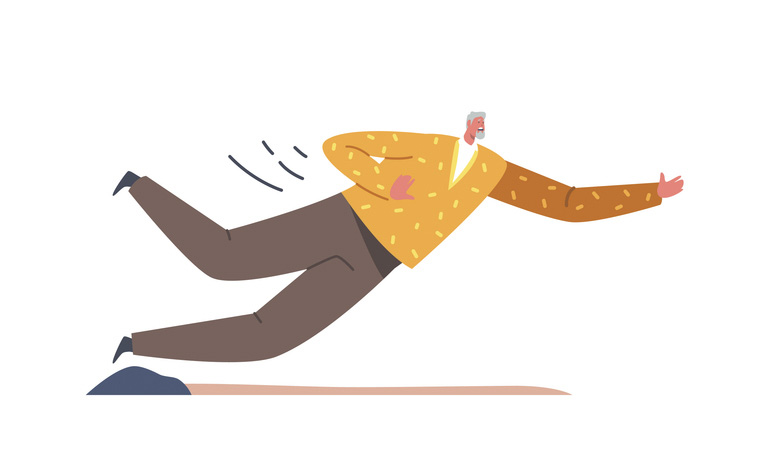
A fall can change one’s life in a matter of seconds, especially as we grow older. A simple trip over a rug or misstep on a staircase can lead to broken bones, months of rehabilitation, or potentially, a permanent loss of independence or worse—not to mention lost quality time with loved ones, including grandchildren. Just trying to “be careful” or removing hazards is not enough because loss of balance can happen to anyone and cannot always be prevented. A better question is: How do we build a body that is capable enough to handle the unexpected?
One of the most powerful and simple answers is: strength training.
Sedentary adults lose muscle and strength as they age faster than their active counterparts. Without regular physical activity, strength can decline significantly, making everyday tasks like standing up from a chair, using stairs, or cooking and cleaning more challenging. Eventually, even a minor loss of balance can become difficult to correct. However, this decline is not inevitable. Those that continue or start strength training can maintain muscle mass and strength well into their later decades.
Strength changes the equation.
Imagine an older adult catching their foot on a curb. The outcome is not necessarily determined by the initial stumble. What happens in the next fraction of a second matters. Can they produce enough force through their legs and hips to take another step? Can they stabilize themselves? Can they push against the ground quickly enough to regain their balance? Greater strength gives the body more capacity to respond when balance is unexpectedly challenged.
This is why strength training should be considered a cornerstone of fall prevention. Stronger legs and hips improve the physical capacity needed for walking, climbing stairs, rising from a chair, and recovering from a misstep. Strength also makes everyday movements less demanding, leaving an older adult with greater physical reserves when something unexpected happens.
But perhaps the greatest argument for strength training is that its benefits extend far beyond preventing falls.
Strength is closely connected to independence and health span. The ability to get out of a chair without assistance, carry groceries, walk through a store, or climb a flight of stairs can determine whether someone continues living life on their own terms. Maintaining muscle and strength allows older adults to participate in the activities that make life meaningful rather than gradually organizing their lives around what their bodies can no longer do.
This makes strength one of the biggest levers an older adult can pull to improve their quality of life. Most importantly, it can help one preserve independence and remain engaged with the world around them.
Of course, strength is not the entire answer. Effective fall prevention should also include balance training, regular vision checks, medication reviews, appropriate footwear, and attention to environmental hazards. Loose rugs, clutter, inadequate lighting, and slippery surfaces can all contribute to falls. However, these measures should complement, not replace, the development of physical capacity and strength.
The good news is that someone does not need to become a bodybuilder to benefit from getting stronger. An inactive older adult can begin with simple movements such as standing from a chair, supported squats (like holding onto a chair or a tabletop while doing squats), step-ups, climbing stairs, and appropriately scaled resistance exercises (see sidebar). Over time, these movements can become progressively more challenging as strength improves. The goal is not to see how much weight someone can lift. It is to build a body that is more capable, resilient, and independent.
Ultimately, fall prevention is about more than avoiding an accident. It is about preparing the body for the demands of everyday life. A stronger person is better equipped to recover from a stumble and continue doing the things they love and spending time with family and friends.
The goal of strength training is not simply to live longer. It is to remain capable of living well.
When it comes to preserving mobility, independence, confidence, and quality of life, getting stronger may be one of the most valuable investments an older adult can make.
 Schedule-Friendly Strength Training Exercises
Here are a couple of exercises from https://embody-fit.com/ that can be done at home without any fancy workout equipment. NOTE: Check with a medical professional before starting any workout routine. A medical professional can help you customize a routine in terms of the number of reps per session and the number of times to do a routine during the week, so it meets your specific health goals and needs.
Bodyweight Box Squat
The Bodyweight Box Squat is a popular powerlifting and strength training exercise that can improve hamstring activation and strength while challenging your core and ability to generate force from a standstill position.
To perform the Bodyweight Box Squat:
- Start in a seated position, sitting on the edge of a box or bench.
- Place your feet so that your ankles are approximately 1-2 inches in front of your knees, so that your knees are slightly wider than 90 degrees bent.
- Place your hands out in front of you with your shoulders locked down and back to increase stability.
- Brace your abdominals and start the movement by leaning forwards at the hips.
- Perform a hamstring curl motion to pull yourself forward into a standing position.
- Allow your torso to flex forward and bend down in order to center your gravity enough to stand.
- Pause briefly in the standing position squeezing your glutes and abdominals.
- Return to the starting position under control by pushing your hips back.
- Lower yourself with control by keeping your core braced throughout the movement.
- Touch your buttocks to the seat briefly without letting go of your braced core.
- Rebrace as you inhale and repeat for the desired number of repetitions.
Correct Form:
- Be sure to check the position of your feet as compared to your knees, making sure that your ankles are in front of your knees instead of underneath or behind.
Common Mistakes:
- Do not slam into or drop onto the box or bench. Lower yourself with control.
- Do not allow your spine to flex or round. Stand and sit tall throughout the movement.
- Do not place your ankles beneath or behind your knees which will shift the focus to your quadriceps.
- Do not arch your back excessively. Keep your abs braced and your spine neutral.
Pro Tip:
Picture that you are trying to rip the floor apart using your heels. This will increase glute activation as your knees track outwards as you stand up.
Step-Up
The Step Up is a popular functional fitness exercise that strengthens your lower body and core while challenging your balance and stability. As a unilateral exercise it is a great choice for improving symmetry and balance.
To perform the Step-Up:
- Start in a standing position facing a stable elevated surface like a box or bench.
- Start the exercise by bracing your core and maintaining the brace through the entire exercise.
- Continue by lifting your working leg as you drive your knee upwards, stepping onto the top of the platform.
- Drive through your lead leg’s heel to lift yourself up onto the platform. You can maintain a slight forward lean to drive yourself forwards and upwards.
- Pause briefly at the top and stand up straight before lowering yourself under control to the starting position.
Correct Form:
- Your knees can go past your toes during the step up.
- Your feet should both face straight
- You should maintain a neutral spine position throughout the entire exercise.
Common Mistakes:
- Do not let your knee collapse inwards as you step up.
- Do not round your back.
- Select a height that you can comfortably step up onto.
Pro Tip:
18 inches or the height of a standard weightlifting bench is a good height for most people performing this exercise.